For Yanis and Francesca
- Hilary Sterne

- May 9
- 6 min read
Updated: May 13
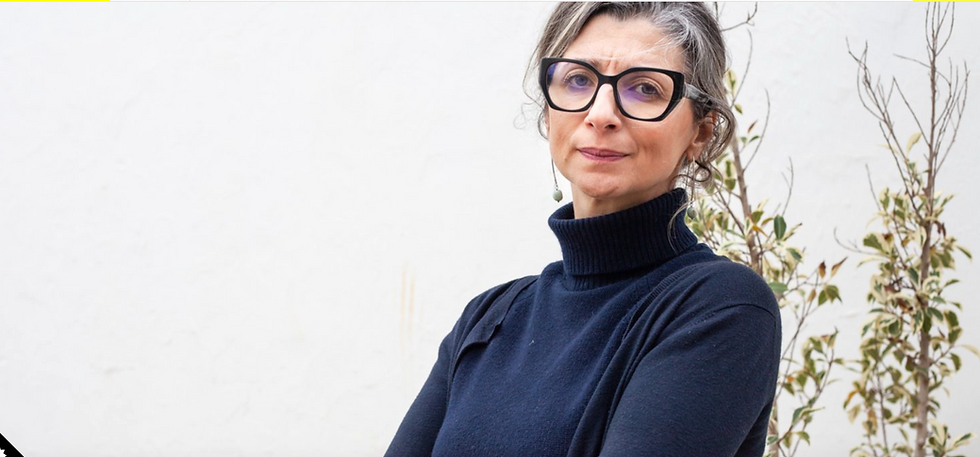
Francesca Albanese: An Inspiration
Today I’m going to post fewer of my own words in order to share those of a man who speaks more eloquently and more urgently for me and for millions of others who now find ourselves unexpectedly standing together on the right side of history.
His name is Yanis Varoufakis and he is a Greek economist, academic, author and politician with more than a million followers on X. He recently gave an extraordinary speech in tribute to perhaps the most extraordinary woman of our time, Francesca Albanese. She is the United Nations Special Rapporteur on the occupied Palestinian territories who has been vilified and punished for speaking out in support of Palestinians and yet she refuses to back down.
Varoufakis compares her to those Germans who helped Jews during the Holocaust, noting the vast majority did not, and that in a grotesque example of history rhyming rather than redeeming, it is all happening once again.
An Understanding
I know this through my own lived experience, having been fired and ostracized for speaking out about the genocide in Gaza and having received threats against my life while I watch most of those around me not only refuse to say anything about the genocide there and now Lebanon but shun those of us who do.
I think of my former friend and co-worker Jean (a.k.a. Mariam—no need to disguise her identity anymore), whose last text to me when I was struggling so hard to cope with all the hatred was “I love you” before she ghosted me. Or Michael, who ghosted me after inviting me to hear a concert with him. Both Jean and Michael are devout Christians who pray to God every night. I wonder if they ever broach this topic with Him. I wonder if Michael, a teacher of history and religion and ethics at a Catholic school In New Jersey, is ever asked by one of his students how the world allowed the Holocaust to happen. And if his answer is ever: "It’s very easy, actually. I’m doing it right now."
But enough about me. The woman you really need to know more about is Francesca. The bravest, most righteous, most principled woman of our time. If anyone can save the world it will be her. She is the apotheosis of love and hope and justice and humanity, and my wish is that she inspires you half as much as she inspires me. What follows is an excerpt from Varoufakis's tribute to her. As always, this post is dedicated to the children of Gaza and Lebanon, who continue to be bombed, burned alive, run over, starved and deliberately sniped during a supposed ceasefire.*
A Tribute From Yanis
There is a question that visits me in the small hours, when sleep will not come and the mind turns over old stones. The question is this: “What would I have done in the 1930s, on the morning after Kristallnacht?"
Not what I say I would have done. Not what I hope I would have done. But what would I actually have done—when the trains began to run, when the neighbours grew quiet, when the cost of decency became the loss of everything?
Most of us, I think, would have done little. Not from malice. From fear. From the soft, creeping conviction that someone else will speak, that the situation is complex, that we must be 'reasonable'. Lest we forget, the ordinary is the extraordinary's alibi. And how we have clung to that alibi! How we still cling to it!
And then, every once in a terrible while, someone appears who does not cling. Someone who steps forward when others step back. Someone who speaks the name of the thing when everyone else is busy naming something else.
Francesca Albanese is that someone.
She stands before the world—alone, unarmed, armed only with law and language and a rare courage—and she says what the centrists will not say, what the foreign ministries will not say, what the editorial boards will not say. She says: "This is a genocide. And we are watching it happen."
Do not tell me that is hyperbole. Do not tell me the term is contested. She has not used it lightly. She has used it as a physician arrives scientifically at a diagnosis—not to wound, but to warn. Not to inflame, but to name.
And for that, they have come for her. Oh, how they have come for her. Smears. Investigations. Vicious editorials. Frozen bank accounts. Dispossession of the only apartment she had ever owned. The machinery of the respectable turned to crush her. Because the respectable cannot abide what she represents: a mirror held up to their complicity.
Let us, once again, travel back to the 1930s. Back to the few who stood up when the trains began to run laden with Jewish people.
There was Aristides de Sousa Mendes, a Portuguese consul in Bordeaux. He defied his own government. He signed thousands of visas, by hand, for hours, until his fingers bled. He saved more lives than Schindler. And he died penniless, disgraced, erased.
There was a German officer in Warsaw named Wilm Hosenfeld. He hid a Jewish pianist in the rubble. He did not save thousands. He saved one. But that one—Władysław Szpilman—carried the memory. And memory is "the only haven from which we cannot be expelled."
There was Raoul Wallenberg. There were the villagers of Le Chambon. There were the anonymous, the quiet, the furious few who said: “Not on my watch.”
Francesca Albanese is their heir. Not because she carries a gun. Not because she hides refugees in her basement. But because she does something equally dangerous in a world that has perfected the art of not seeing. She sees. And she speaks.
She does not speak as a diplomat. Thank Goodness she doesn't! Diplomats have given us the language of "there are arguments on both sides" and "restraint" and "proportionality." Diplomatic language is the perfumed grave of moral clarity. No, she speaks as a jurist. As a human being. As a woman who has looked into the abyss and refused to call it a "complex geopolitical landscape".
Edna O'Brien once described a character who "had the recklessness of those who have already lost everything worth losing." Francesca Albanese has not lost everything. She has her dignity, her office, her voice, her family. But she has calculated the cost of speaking truth to power. And she has decided that that cost is infinitely less than the cost of silence.
What is that cost? Let us name it. She has been called antisemitic—she, who stands on the ground of international law forged in the ashes of Auschwitz and the fires of Nuremberg. She has been called a conspiracy theorist—she, who cites every source, every footnote, every UN resolution. She has been called naive—she, who understands better than most the machinery of realpolitik.
These accusations are not arguments. They are the spittle of the threatened. Because Francesca Albanese threatens something very precious to the powerful: the right to commit atrocity without being named.
Friends, the 1930s did not arrive with jackboots and pogroms on day one. They arrived in small increments. With "reasonable" restrictions. With "proportional" measures. With the silence of the respectable.
We tell ourselves that we would have been different. That we would have been Sousa Mendes. That we would have been Wallenberg. But most of us, I fear, would have been the neighbours who later said, "I didn't know."
Francesca Albanese knows. And she refuses to pretend otherwise.
So let us praise her. Not with statues or awards she does not seek. But with something harder: with our own refusal to look away. With our own voices, raised in places that are safe for us but dangerous for her. With our own bodies, if it comes to that.
A brave woman, who was injured while demonstrating outside a US nuclear military base in 1982, the infamous Greenham Common, had told me that "the heart is a hunter for what it cannot have." But I say the heart is a hunter for what it will not lose. And what we will not lose is the memory of those who stood up when standing up cost everything.
Francesca Albanese is standing up now. In our time. In our name. Under our indifferent sky.
Let us stand with her.
Not tomorrow. Not when it is safe. Now.
*Update. According to the AP, on May 10th, the IDF targeted a man and his 12-year-old daughter who were riding on a motorbike in southern Lebanon. The two survived the initial drone strike and attempted to flee, whereupon they were targeted a second time. The father was killed but the girl ran approximately 100 yards, where she was targeted for a third time. She later died in a hospital. According to Save the Children, Israel has killed an average of four children a day in Lebanon in the 25 days since the ceasefire went into effect. And it continues. Yesterday, on May 12th, two children were among at least eight people killed in their cars by airstrikes on vehicles on the Beirut-Sidon highway. There is no evidence any of the victims were in any way associated with Hezbollah. Most likely they were attempting to flee to safety.


Comments